Families change.
We know this, of course. Children grow up. They develop their own interests, make their own choices, and eventually build lives that don’t always look like the ones we imagined for them. But knowing that families change and knowing how to change with them are two very different things.
As leaders, we talk a lot about creating cultures of belonging. We want people to feel valued for who they are and know that they have a place on the team. We understand that people shouldn’t have to become just like us in order to belong with us.
But what happens when we bring that leadership lesson home? What happens when the people we raised begin making choices that challenge not just our preferences, but some of our deeply held values?
That’s when belonging gets tested.
When Our Values Become Their Choices
Education has always been important in our family. For both my husband and me, education represented much more than earning a degree. It was an escape from poverty. It created access and opportunity. It changed the trajectory of our lives.
So, naturally, we wanted that for our sons.
For a long time, I probably didn’t think of college as one possible path after high school. It was simply the path. You finished high school, went to college, earned a degree, and used that education to begin building your career. It had worked for us. We had experienced firsthand what education could make possible. Why wouldn’t we want our children to follow that path?
But eventually, I had young men making decisions of their own. One went to college and later decided that law school—the dream he had once imagined for himself—was no longer the future he wanted. Another questioned whether college was the right path at all.
Those choices required me to examine something I hadn’t really considered when they were younger: At what point does the path we prepare for our children become theirs to choose?
Faith brought another version of the same question.
Church wasn’t simply somewhere we went on Sunday. Faith was woven into the fabric of our family. It shaped how we raised our children, how we made decisions, and how we navigated some of the most difficult seasons of our lives.
Proverbs 22:6 tells us, “Train up a child in the way he should go: and when he is old, he will not depart from it.” I took that responsibility seriously.
But there’s something important in that scripture that becomes clearer when our children become adults. We are called to train them. Eventually, they have to choose how they will walk.
Watching my young adult sons make their own decisions about whether, where, and how they worship forced me to consider whether I was nurturing the faith I had planted or trying to control what that faith should look like. That’s not an easy distinction when something matters deeply to you.
Belonging Doesn’t Require Agreement
Strong family leadership doesn’t mean abandoning our values every time someone we love chooses differently. I still believe deeply in education. I still believe in the importance of faith. I can share what I have learned, offer perspective, and even disagree with the choices my adult children make.
Belonging doesn’t require agreement.
But it does require us to pay attention to what happens after the disagreement. Does disappointment become distance? Does concern become constant correction? Does every conversation eventually circle back to the decision we wish they would reconsider? Do the people we love begin editing what they tell us because they’ve learned which parts of their lives are easier to leave outside the door?
Those questions matter because belonging isn’t measured by how welcome people feel when they agree with us. It’s revealed by what happens when they don’t.
Our children shouldn’t have to hide parts of themselves to preserve their place in the family. They should be able to bring their questions, their choices, their uncertainty, and even their mistakes home without wondering whether there is still room for them. That doesn’t mean every choice is celebrated. It means the person is still embraced.
Leaving Room for Who They Become
I think one of the hardest transitions in parenting is learning to make room for who our children become instead of holding too tightly to who we expected them to be.
We spend years preparing them. We teach, model, correct, encourage, and expose them to the things we believe will help them thrive. And then, if we’ve done our job, they begin making decisions without us.
That’s the point, isn’t it?
There is a subtle shift that has to happen in our leadership. The values we worked so hard to instill don’t disappear, but our role changes. We move from directing so much of their path to creating a relationship where they know they can still come home and talk about where that path is taking them.
Sometimes leaving room at the table means leaving room for people to change. It means understanding that the family can have a strong identity without requiring everyone in it to have an identical one. Traditions can remain meaningful without becoming tests of belonging. Values can remain strong without every person expressing them in exactly the same way.
We don’t have to erase what was there before to make room for what comes next.
There Is Still a Place for You
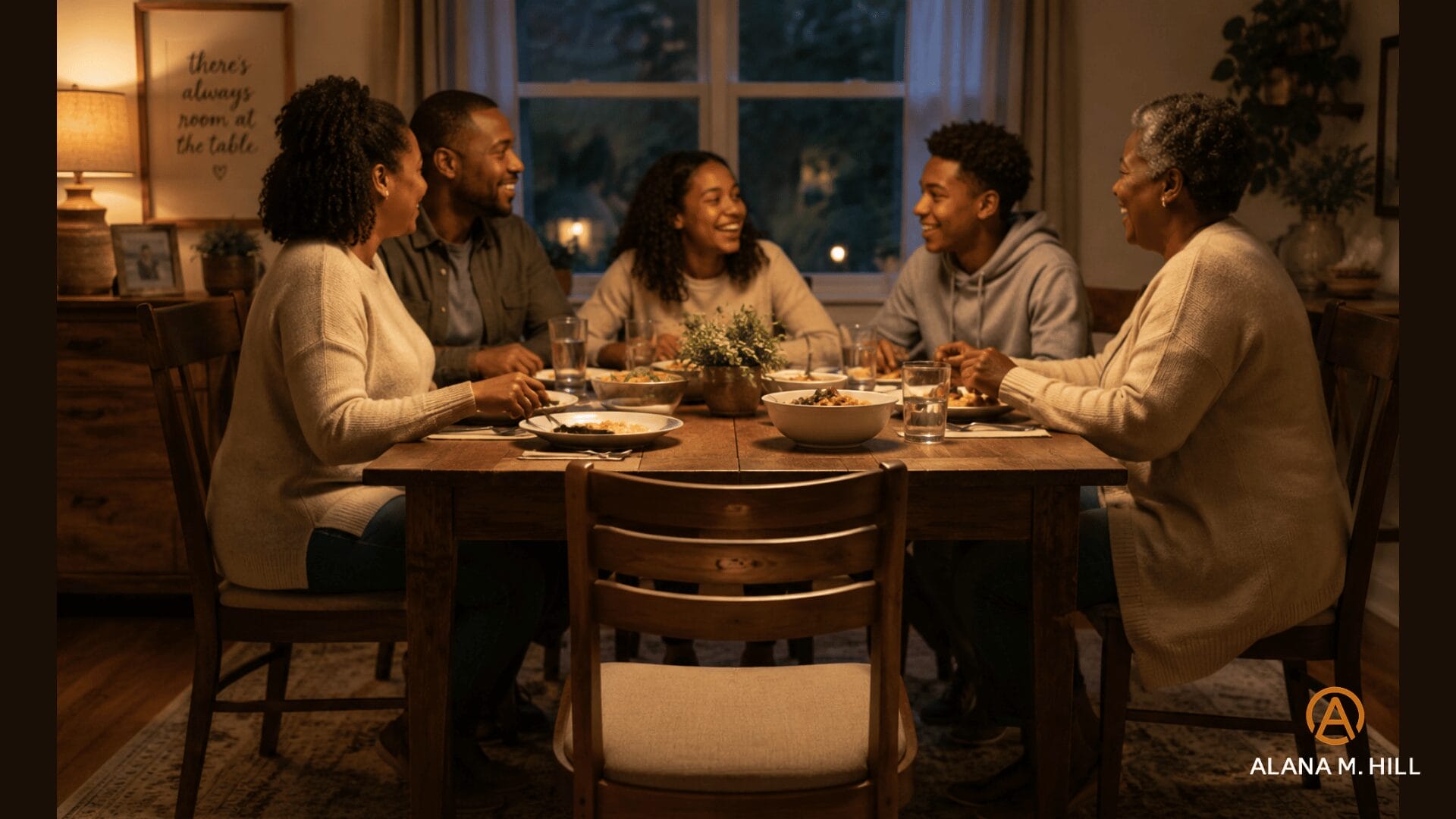
The table has become an interesting metaphor for me as my family has grown and changed.
When children are young, we decide so much about what happens around that table—what we eat, when we gather, what we talk about, what we believe, and what we celebrate. We are intentionally creating a family culture.
Then those children grow up. They leave the table and encounter other tables, other ideas, other experiences, and other ways of seeing the world. And when they return, they don’t always come back exactly as they left.
Strong family leadership makes room for that. Not because our values no longer matter, but because belonging matters too.
We can hold onto what we believe while loosening our grip on the belief that everyone we love must live it exactly as we do. We can offer wisdom without making wisdom the price of admission. We can disagree without disconnecting.
Perhaps that’s one of the most important transitions we make as family leaders. We spend years preparing our children to leave the table and build lives of their own. And then we make sure they know there will always be room when they come back.
Not because they became who we expected them to be.
Because they belong.
Previous posts in this series:
Listening Beyond Words: Sometimes the Loudest Conversations Never Use Words
The Family Team: Creating a Culture of Contribution at Home
One Home, Many Needs: Why Strong Family Leadership Makes Room for Difference
From Me to We: Why Interdependence Makes Families Stronger
Before You Feel Seen, See Yourself: Why Self-Awareness Is the First Step to Belonging