
Update: Why This Conversation Matters Even More Now (May 2026)
When I originally wrote this article, I was focused on helping leaders better understand the role emotional intelligence plays in how we show up for our teams—especially in moments that matter.
Today, that conversation feels even more urgent.
Recent research from Gallup shows a continued decline in employee engagement, with fewer employees feeling connected, motivated, or inspired at work. In fact, their latest findings highlight that many organizations are experiencing what I often describe as a dimming of the spark—that energy, ownership, and commitment that fuels performance and culture.
👉 You can explore the full findings here.
This is not just a workforce trend—it’s a leadership moment.
Because when engagement declines, it’s rarely just about workload or processes. It’s about how people feel:
- Do they feel seen?
- Do they feel valued?
- Do they feel understood?
And that brings us right back to emotional intelligence.
If we want to reignite that spark, we have to lead differently. More intentionally. More empathetically. More aware of how our actions—and our reactions—impact the people we lead.
So, as you read (or revisit) this article, I invite you to consider:
Where might the spark be dimming on your team—and what role can you play in reigniting it?
These are times of heightened emotions.
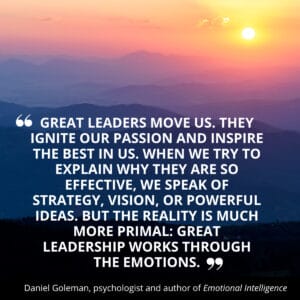
What we are seeing, hearing and experiencing is through our emotions.
I have studied, written about and applied emotional intelligence throughout my life and career (sometimes without even realizing it at the time), to the point that it is embedded in my practice. However, it always serves us to take a step back, consider the current context and expand our understanding. To that end, let’s unpack: What has emotional intelligence got to do with leadership?
The tumultuous events of recent years have surfaced the indispensable nature of emotionally intelligent leadership. As conflict and uncertainty envelop our world, the ability to understand others, build trust, and unify teams has never been more urgent.
What exactly is emotional intelligence (EQ) and why is it so pivotal to impactful leadership?
EQ is our capacity to be aware of, control, and constructively express our emotions while understanding the feelings of others and navigating relationships empathetically. Decades of research reveal EQ is a key ingredient for leadership success.
Studies at Harvard and other institutions have found that leaders with higher EQ inspire greater loyalty, performance, and commitment from their people. Teams resonate with authentic, unifying leaders who radiate purpose and care. Consider the soaring approval of Ukraine’s President Zelensky during times of crisis.
Leaders with empathy and social awareness can decode emotional undercurrents within their organizations. They foster psychologically safe environments where people take risks, innovate, and thrive. Research shows teams with shared trust and purpose are exponentially more effective.
Meanwhile, the absence of EQ in leaders breeds disconnect, friction, and dysfunction. We’ve all seen ego-driven bosses damage morale and productivity through callousness, volatility, or poor communication. The costs are immense.
The good news is EQ can be learned and it’s never too late to start. Here are four ways to boost your leadership emotional intelligence:
- Hone your listening skills – Give people your full presence and undivided attention.
- Express appreciation and validate others’ feelings – This builds tremendous goodwill.
- Keep calm under stress – Regulate your own emotions even when turmoil swirls around you.
- Connect on a human level – Share experiences, ask about people’s lives, and find common ground.
For organizations to thrive, they need leaders who can unify, inspire, and resonate emotionally. The message is clear – EQ capabilities must be prioritized in emerging leader development.
With self-awareness, role modeling, and consistent practice, we can all become more emotionally intelligent, empathetic leaders. The reward will be bringing out the best in our people and organizations. That’s a powerful legacy to strive for.
On the subject of legacy – great leaders create leaders. Here are some ways experienced leaders can leverage their emotional intelligence to develop emerging leaders:
- Coach them on self-awareness – Help them identify their strengths, work preferences, stress triggers, and growth areas. Give them assignments that build self-knowledge.

- Encourage open communication – Create a trusting, nonjudgmental environment where emerging leaders feel safe to voice concerns, admit mistakes, and ask for help.
- Provide constructive feedback – Give regular, compassionate feedback focused on their development needs and how they can continue improving.
- Teach relationship management – Share best practices for conflict resolution, influencing, and relationship building across the organization. Role model these skills.
- Inspire passion and purpose – Remind emerging leaders of the meaning behind their work. Your own passion and empathy will motivate them.
- Offer mentorship – Share your own experiences, lessons learned, and guidance. Provide a listening ear during challenging times.
- Build their confidence – Recognize their accomplishments and growth. Have them lead initiatives matching their abilities so they can stretch their skills.