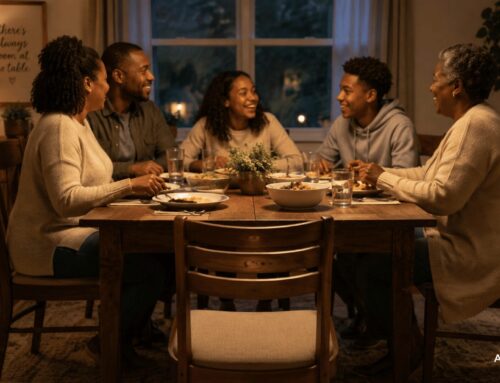

One of the biggest challenges we face in leadership, both at work and at home, is remembering that we are not leading ourselves. We are leading someone else—someone who is their own unique individual.
In the workplace, this shows up in the teams we lead. We know that not every employee is motivated the same way, processes information the same way, or responds to pressure the same way. We know that one person may need clarity and structure while another needs room to think out loud. We know that one-size-fits-all leadership is so 1999 and rarely brings out the best in a team.
And yet at home, where the relationships are more personal and the emotions are closer, it can be easy to forget that same truth.
The people inside our homes are not extensions of us. They are not replicas of us. They are not younger versions of us who should naturally think the way we think, want what we want, or respond the way we respond. They are individuals. And one of the most important leadership assignments we have at home is learning how to lead them that way.
The people in your home are not all wired the same
Sometimes biology shows up strong. My youngest son literally stole my face. He looks just like me. But even in looking just like me, he is still very much his own person. He has his own preferences, his own way of responding, his own likes and dislikes, and his own way of moving through the world.
That’s true in every home.
The people we live with may share our last name, our address, our routines, and in some cases our facial features. But they do not all share the same personality, the same emotional wiring, the same talents, or the same needs. One person may be expressive and easy to read. Another may feel just as deeply but show very little on the surface. One may want encouragement spoken out loud and often. Another may hear the same words and quietly shrink from the attention.
None of that is wrong. It’s just different.
The challenge is not simply recognizing those differences. The challenge is recognizing them without creating a hierarchy around them. Without deciding that the child who is more verbal is easier to lead. Without deciding that the person who responds the way I respond is somehow more reasonable, more cooperative, or more “right.” Without treating one temperament as normal and another as a problem to solve.
Healthy leadership at home requires us to notice difference without ranking it.
Difference is not dysfunction
That distinction matters because families, just like teams, can drift into a one-size-fits-all model without even realizing it. We can begin to assume that everyone should want the same things, communicate the same way, hit the same milestones, and respond to the same kind of support. And when someone doesn’t, we start trying to lead them back toward our preferred version of “normal.”
But different does not automatically mean difficult. And different certainly does not mean deficient.
Equity-based leadership gives us a better lens. It reminds us that different people need different things in order to thrive. At work, that may mean adjusting how we communicate, coach, or give feedback. At home, it may mean recognizing that one child lights up with verbal praise while another would rather receive quiet support and not be put on display. It may mean understanding that one person wants to talk through disappointment immediately while another needs time and space before they can find the words. It may mean realizing that what feels encouraging to one person feels overwhelming to another.
The goal is not to make every interaction identical. The goal is to lead each person well enough to understand what support looks like for them.
As parents, we have to ask a different question
As parents, especially, it can be tempting to create one standard path for everyone in the house. One way to communicate. One way to receive affirmation. One definition of success. One timeline for growth.
But people don’t thrive in one-size-fits-all environments. Families don’t either.
So one of the questions I think we have to ask at the end of the parenting journey is not simply, Did they all do well by the same standard? It’s something deeper than that.
How well did each of my children thrive according to their purpose, their talents, and their capabilities?
That is a very different question.
Because when we measure everyone by the same milestones, the same accomplishments, or the same expression of success, somebody in the family inevitably ends up feeling like they don’t fit. And when someone feels like they don’t fit in their own home, we have missed something important.
Making room for difference without losing the structure of the home
Of course, recognizing difference does not mean the household revolves around every preference. It does not mean every opinion becomes a new policy or every dislike requires a full system overhaul. That’s not leadership either.
I think about this in practical ways. One day, my middle son simply declared that he no longer liked cheese. This was deeply disappointing to me as someone who loves cheesy mac, cheeseburgers, and honestly just about anything with cheese. As the cook in that season, I had a choice to make.
My goal was not to become a short-order cook and make everyone something different. But I did learn the value of making room for difference where I could. Sometimes that meant pulling something out of the skillet before I added the cheese so I could create a variation of the same meal. It didn’t cost me much. It didn’t require me to make a separate dinner. But it did go a long way in helping him feel seen and heard.
That’s what leadership at home often looks like. Not catering to every preference. Not restructuring the entire household around one person’s momentary wants. But paying enough attention to know where a small accommodation can communicate something big.
I see you.
I know what matters to you.
There’s room for you here, too.
That is different from surrendering the leadership of the home. In fact, it is part of leading the home well.
Strong leaders know how to hold both things at once: structure and flexibility, consistency and compassion, family values and individual needs.
One home, many needs
If we want our home team to be just as healthy as our work team, then we have to lead with that in mind. We have to recognize differences, respect differences, and create a home where each person has room to thrive.
Not because everyone gets the same thing.
But because everyone matters enough to be led with care.
That is the work of leadership at home. Not making everyone the same. Not forcing one personality, one path, or one way of thriving. But learning the people in front of us well enough to know what they need, how they are different, and how to create a home where those differences are not merely tolerated, but respected.
One home. Many needs.
And healthy families make room for difference.
Previous posts in this series:
From Me to We: Why Interdependence Makes Families Stronger
Before You Feel Seen, See Yourself: Why Self-Awareness Is the First Step to Belonging