
An effective weapon doesn’t have to be new—it just has to be familiar, emotionally charged, and poorly understood. Right now, that weapon is merit.
In a recent Los Angeles Times essay, David Glasgow explains how the language of meritocracy is being deliberately used to undermine culture-change efforts. Calls to “restore merit-based opportunity” suggest that fairness has somehow been lost—when in reality, fairness has often been selectively applied. The implication is subtle but powerful: if inclusion exists, merit must be absent.
That framing is not only misleading—it ignores history.
Merit has never been evaluated in a vacuum. Who is seen as competent, credible, or “a natural fit” has always been shaped by bias, access, and long-standing systems that favored some while excluding others. The real issue isn’t that merit has been replaced—it’s that it has never been evenly recognized.
This is why reclaiming merit matters. Not to defend the status quo, but to challenge it.
Merit Has Been Weaponized—But It Doesn’t Belong to Opponents of Inclusion
In the essay, Glasgow—along with his coauthor Kenji Yoshino—argues in their forthcoming book HOW EQUALITY WINS that equality advocates must reclaim the language of merit rather than abandon it.
Their reasoning is both pragmatic and principled.
One of the primary reasons organizations still need diversity and inclusion efforts is because people have historically not been assessed on merit alone. Racism. Sexism. Nepotism. Bias. These forces have shaped who gets opportunities, who advances, and who is believed—often independent of actual capability.
Avoiding the word merit only reinforces the misconception that it belongs to those who oppose inclusion. It doesn’t.
The Reality: Merit Has Never Been Applied Equitably
We like to believe merit is neutral. Objective. Fair.
But lived experience tells a different story.
Black doctors routinely report being ignored, second-guessed, or mistaken for non-clinical staff by patients who cannot imagine a Black person as a physician. These are professionals who:
- Completed medical school
- Passed rigorous licensing exams
- Earned the same credentials as their peers
Yet their expertise is still questioned in real time.
That is not a failure of merit.
That is a failure of culture.
When You Have to Prove Merit Again—and Again
I know this dynamic personally.
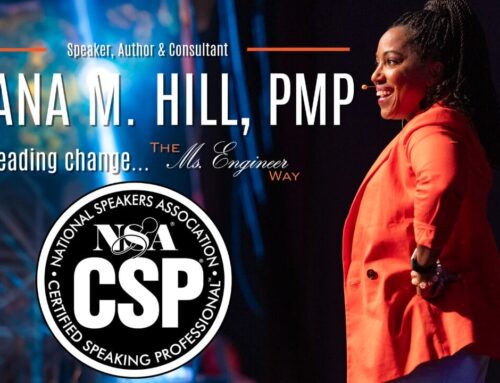
I hold a B.S. in Petroleum Engineering, a credential that is still questioned far more often than it should be. Over the years, I’ve learned that my expertise is frequently met with skepticism—until I provide additional “proof.”
When I earned my Project Management Professional (PMP) certification, acing the exam became another data point I could point to in defense of my competence. Not because the credential suddenly made me capable—but because merit, for some of us, must be continually defended.
That’s the part of the merit conversation that often goes unspoken.
For many professionals, merit is not assumed.
It is interrogated.
Why This Is a Culture Change Conversation—Not a Compliance Debate
This moment is not about lowering standards. It never has been.
It’s about mending merit, not ending it.
Culture change requires leaders to ask harder, more honest questions:
- Who defines merit in this organization?
- Whose competence is presumed—and whose must be proven repeatedly?
- Where do bias and tradition distort our assessments of excellence?
True meritocracy can only exist when everyone has equitable access to demonstrate their capabilities—and when those capabilities are recognized without prejudice.
That is the work ahead.
Reclaiming merit is not a retreat from excellence.
It is a recommitment to it.